

Why We Use Dark Humor to Cope: Military Humor Shirts and Resilience
Feb 26, 2026
There's a joke that goes around fire stations and TOCs: "What's the difference between a fairy tale and a war story? One starts with 'Once upon a time...' and the other starts with 'No shit, there I was...'"
If you have to ask why that's funny, you probably won't get the rest of this post either.
Dark humor isn't just a quirk of military culture. It's a survival mechanism. A psychological pressure valve. A way to process the kind of weight that would crush most people if they carried it in silence. And for those of us who've been there, in the sandbox, on the line, running calls at 3 AM, it becomes part of our language. Part of our identity.
That's why we wear it on our chests.
Funneling Trauma, Not Dulling It
Let's get one thing straight: dark humor doesn't make the hard stuff go away. It doesn't numb you or turn you into a callous psychopath who can't feel anymore. What it does is give you a way to funnel the grief, the anxiety, the absurdity of what you've seen.
Research backs this up. When military personnel use dark humor, they're not suppressing their emotions, they're managing them. They're taking feelings that could spiral into despair and channeling them through shared laughter with people who understand. It's the difference between drowning in it and learning to tread water.
You still feel everything. You just don't let it consume you.
That's why the guy who just got back from a rough deployment will crack a joke about it before he'll talk about it seriously. The humor creates distance. Not from the experience, but from the paralysis that can come with it. It's a way of saying, "Yeah, that happened. And I'm still here."
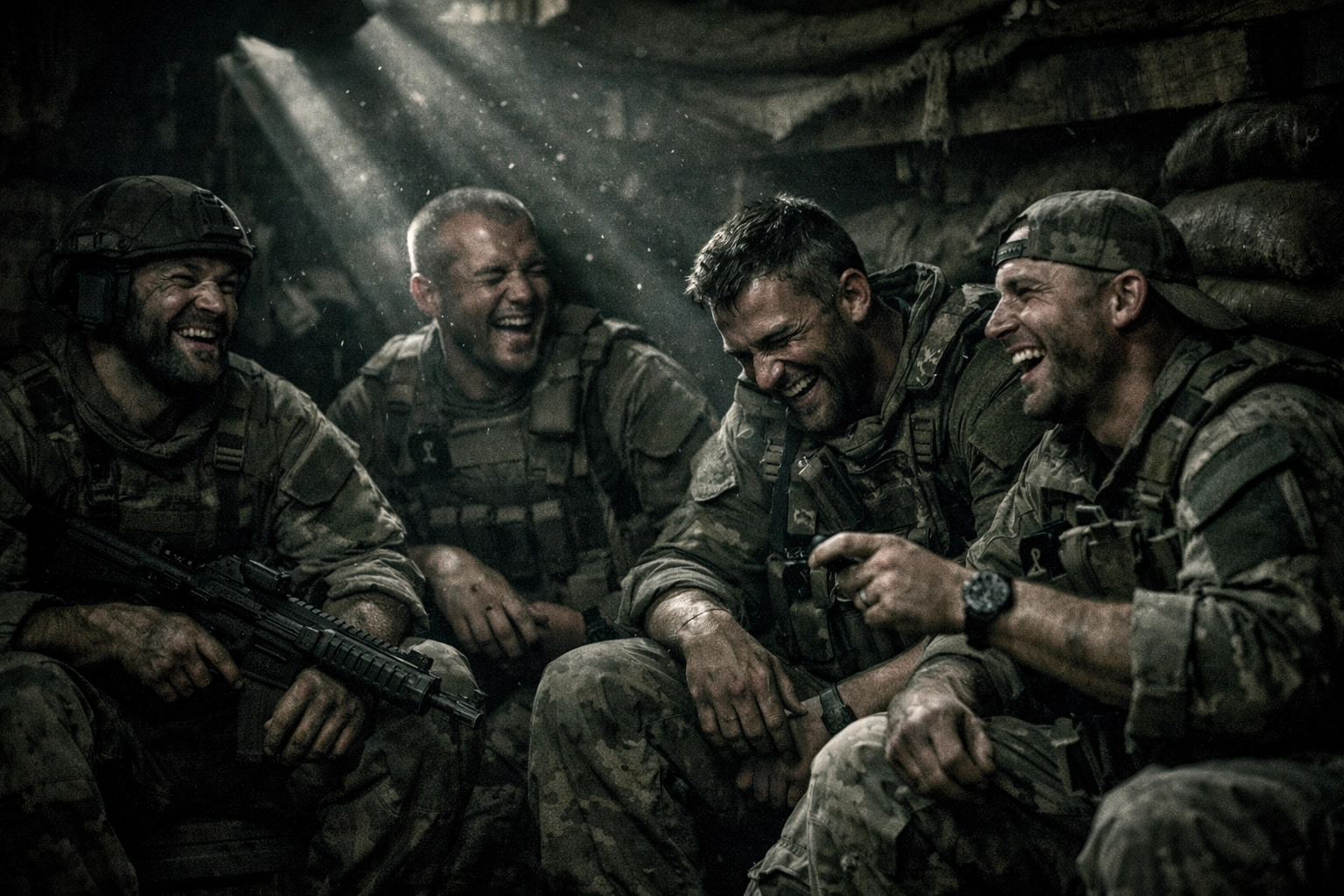
The Brotherhood of Shared Darkness
Here's what civilians don't always understand: the darkest jokes are the ones that bond us tightest.
When you're standing with someone who's been through the same fire you have, and one of you makes a comment that would horrify a room full of regular people, and the other person laughs, that's connection. That's recognition. That's the unspoken acknowledgment that you both know what it's like to operate in places where the rules are different and the stakes are life and death.
Dark humor creates in-groups. It's a litmus test. If you get it, you've been there. If you don't, you haven't. And that's not gatekeeping, it's just reality. The joke about "voluntary skydiving without a parachute" doesn't land the same way if you've never seen what actual kinetic operations look like.
This is why military humor shirts resonate so deeply in veteran communities. When you see someone wearing a shirt that says "I Survived Getting Out Of Bed Today," you know they're not just being edgy. They're signaling membership in a tribe. They're saying, "I speak this language too."
It's the same reason firefighters, cops, medics, and combat vets all gravitate toward the same type of humor. We've all dealt with chaos. We've all seen things break down. And we've all learned that sometimes the only response that makes sense is to laugh at how absurd it all is.
Cognitive Resilience Through Comedy
There's actual science here, not just anecdotal bro-veteran wisdom.
Studies show that people who appreciate dark humor tend to have higher cognitive resilience. They resist negative feelings more effectively. They show lower aggression even when dealing with heavy subjects. In other words, the ability to find humor in darkness isn't a character flaw, it's a strength.
For combat veterans and first responders, this matters in a practical way. The job doesn't stop being hard. The calls don't stop being traumatic. The deployments don't stop stacking up. Dark humor becomes a daily tool for compartmentalization, not in a "bury it deep and pretend it's fine" way, but in a "I acknowledge this sucks and I'm going to keep moving anyway" way.
That's resilience.
When you're running on four hours of sleep, dealing with bureaucracy that makes no sense, and preparing for the next crisis that's always just around the corner, you need ways to stay sharp. Dark humor keeps you from taking everything so seriously that you freeze up. It keeps you nimble. It keeps you functional.
And yeah, sometimes it keeps you sane.
Breaking Taboos, Building Rapport
One of the reasons military humor shirts work is because they let us talk about serious things without sounding preachy or melodramatic.
You can't always walk up to someone and say, "Hey, I'm struggling with the weight of everything I've seen and I'm not sure how to process it." That's vulnerable. That's hard. And in a lot of military and first responder cultures, that kind of openness doesn't come naturally.
But you can wear a shirt that says "My Therapist Says I Need An Outlet, So I Bought This Shirt" and start a conversation that way. The humor breaks the ice. It signals that you're self-aware. It opens the door without forcing anyone through it.
Dark humor allows us to discuss taboo topics, PTSD, moral injury, survivor's guilt, the challenge of transitioning back to civilian life, without making it a therapy session. It's constructive feedback wrapped in sarcasm. It's acknowledgment wrapped in a punchline.
That's why we make the shirts we make. Not because we think trauma is a joke, but because humor is one of the few tools that lets us carry it without collapsing under the weight.
When Dark Humor Goes Wrong
Here's the part where we pump the brakes for a second.
Not all dark humor is created equal. And not all of it is healthy.
Research shows that while general dark humor use isn't directly linked to well-being, self-defeating dark humor, the kind where you're constantly tearing yourself down, is associated with lower life satisfaction. There's a difference between laughing at the absurdity of a situation and using humor as a weapon against yourself.
The same goes for humor that punches down or dehumanizes others. When suffering escalates beyond normal standards and the jokes start crossing ethical lines, that's when dark humor shifts from a coping mechanism to a red flag. If you're using humor to avoid accountability or to justify harm, you're not coping, you're deflecting.
The best military humor punches up at the system, or sideways at shared experiences. It doesn't target the vulnerable. It doesn't mock suffering for the sake of cruelty. It finds the absurdity in the darkness without becoming the darkness itself.
That's the line. And if you've been around long enough, you know when someone crosses it.
Wearing It On Your Chest
So why do we turn this humor into apparel?
Because identity matters. Because signaling matters. Because when you're navigating a world that doesn't understand what you've been through, it helps to wear something that says, "I'm one of you."
Funny veteran shirts aren't just fashion statements. They're tribal markers. They're conversation starters. They're ways of processing heavy experiences in public without having to explain yourself to every stranger who asks, "So what was it like over there?"
When someone sees your shirt and nods, or laughs, you know they get it. And that connection, however brief, is part of what keeps the community alive.
We don't make military humor shirts because we think everything's a joke. We make them because humor has always been part of how warriors cope. From the trenches of World War I to the firebase in Afghanistan, soldiers have cracked jokes in the worst possible moments. Not because they don't care, but because they care too much to let it break them.
The shirt is just the peacetime version of that same instinct.
Still Standing
At the end of the day, dark humor is about defiance.
It's a way of saying, "Yeah, I've seen some shit. And I'm still here. And I'm not going to let it define me in a way that makes me small."
It's not for everyone. And that's fine. But for those of us who speak this language, it's non-negotiable. It's how we process. It's how we bond. It's how we keep moving forward when everything inside us wants to stop.
So if you see someone wearing a shirt with a joke that makes you uncomfortable, just remember: they're not wearing it for you. They're wearing it for the others who've been there. The ones who'll see it and know exactly what it means.
And maybe that's the most resilient thing of all: refusing to let the weight win, one dark joke at a time.

