

Tactical Shirts 101: Why Fabric Choice Matters (Poly-Cotton vs. 100% Cotton)
Feb 25, 2026
Your shirt matters more than you think.
Not in some fashion-forward, Instagram-aesthetic way. I'm talking about the difference between a shirt that holds up when you're drenched in sweat at 1400 hours in August versus one that clings to you like a wet blanket and stays that way until you peel it off six hours later.
Most people buying tactical shirts focus on the design: the patch, the graphic, the message. That's cool. We get it. But if the fabric underneath that design is garbage, you're wearing a billboard that falls apart after three washes or becomes a soggy mess the first time you actually use it.
Let's talk about what actually matters when you're picking tactical t shirts: the fabric blend.
The Two Contenders
Walk into any tactical gear shop and you'll see two main fabric options: poly-cotton blends and 100% cotton. Both have their place. Both have die-hard fans. And both will let you down if you don't understand what you're actually buying.
Here's the thing the big box stores won't tell you: there's no perfect fabric. There's only the right fabric for your specific use case.
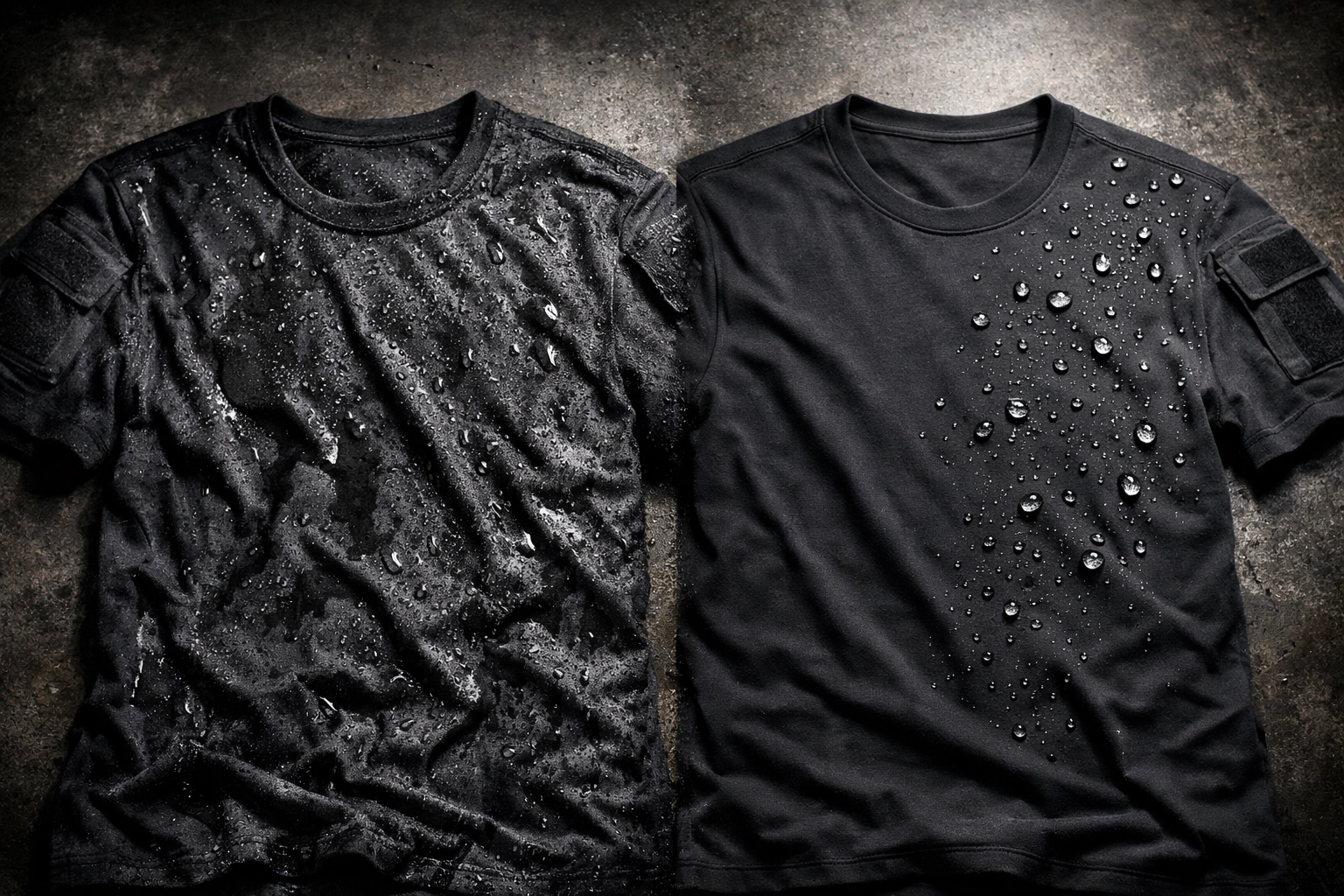
Poly-Cotton Blends: The Workhorse
The military figured this out decades ago. After years of soldiers sweating through 100% cotton uniforms that stayed wet, never dried, and chafed like sandpaper, they switched to poly-cotton blends. Most commonly, you'll see 50/50 or 60/40 polyester-to-cotton ratios.
Why? Because polyester brings the durability. Cotton brings the breathability. Together, they create something that can actually handle what you throw at it.
Polyester is synthetic. It's engineered. It doesn't absorb water the same way natural fibers do, which means it dries faster. It holds its shape better. It doesn't fade as quickly when you wash it for the hundredth time. It's also more resistant to abrasion: important when you're rucking with a 40-pound pack or crawling under obstacles.
Cotton is natural. It breathes. It feels good against your skin during extended wear. It absorbs sweat initially, which can actually feel comfortable in the short term. But that absorption becomes a problem fast when you're in the field for hours and that moisture has nowhere to go.
The blend gives you both. The polyester wicks moisture away from your body while the cotton maintains enough breathability to keep you from feeling like you're wearing plastic wrap. The result? A tactical shirt that dries faster, holds up longer, and doesn't feel like you're being suffocated.
At Thirty Seconds Out, most of our tactical shirts use poly-cotton blends because they simply perform better under real-world conditions. We're not making fashion statements. We're making gear that works.
100% Cotton: The Comfort Play
Don't write off 100% cotton entirely. There's a reason it's been used for centuries.
Cotton is breathable in a way that synthetic fabrics can't fully replicate. When you're stationary or in cooler climates, a 100% cotton shirt feels better against your skin. It's softer. It moves naturally. It doesn't have that slightly plasticky feel that some people can't stand.
For casual wear: throwing on a shirt with a No Weak Shit patch for a brewery run or just hanging out: 100% cotton is solid. It's comfortable. It looks good. And if you're not pushing hard or expecting to sweat through it, the moisture retention isn't a deal-breaker.
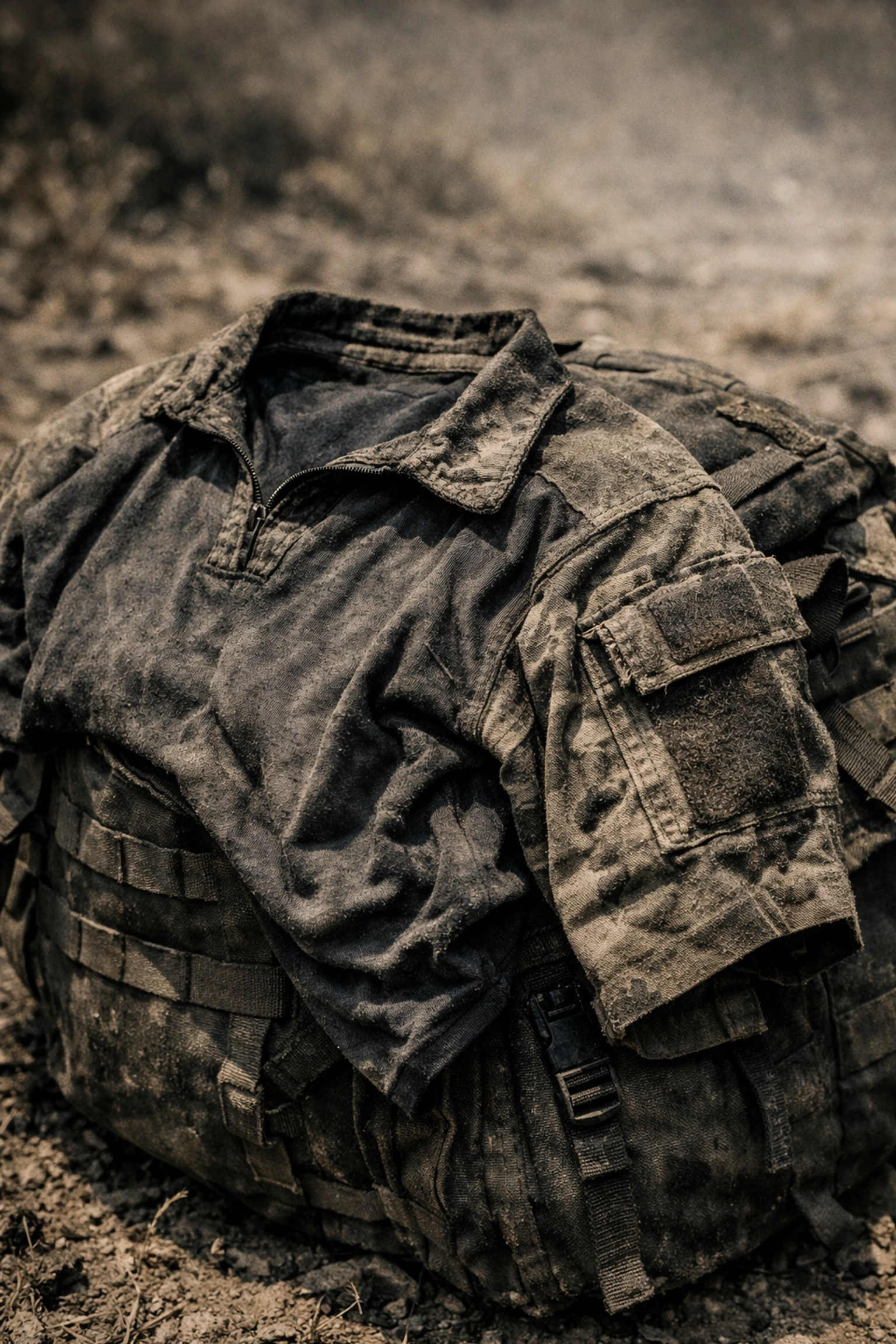
But here's where 100% cotton fails: heavy exertion.
Cotton absorbs moisture and holds onto it. When you sweat hard, that shirt gets wet and stays wet. It clings to your body. It gets heavy. And it takes forever to dry. If you're training, working, or doing anything that requires sustained physical output, that wet cotton becomes a liability.
I've seen guys in 100% cotton tactical shirts during summer ranges. By hour two, they look like they jumped in a pool. The shirt is stuck to them, chafing their skin, and they're miserable. That's not a fabric designed for performance: it's a fabric designed for comfort in controlled environments.
The Tactical Difference: Form and Function
Here's what separates actual tactical shirts from the stuff you find at Target: fit and purpose.
Tactical t shirts should be form-fitting without being skin-tight. You want enough room to move, but you don't want excess fabric bunching up under a plate carrier or getting caught on equipment. A well-designed tactical shirt sits close to your body, moves with you, and doesn't create friction points.
Breathability matters even more when you're wearing body armor or load-bearing gear. You've already got layers trapping heat. The last thing you need is a shirt that adds to the problem instead of managing it.
That's why the fabric blend isn't just about comfort: it's about operational effectiveness. A shirt that stays wet creates hot spots. A shirt that chafes creates distractions. A shirt that falls apart after three months creates waste.
When you're picking tactical shirts, think about where you'll actually wear them. Training? Field work? Daily carry? Casual wear? Match the fabric to the mission.
What We Use and Why
At Thirty Seconds Out, we default to poly-cotton blends for most of our tactical shirts because we're building for people who actually use their gear. We're not interested in making shirts that look cool on a hanger but fail when you need them.
Our blends are typically 60% cotton and 40% polyester. That ratio gives you enough cotton for breathability and comfort during all-day wear, but enough polyester for moisture management and durability when things get real.
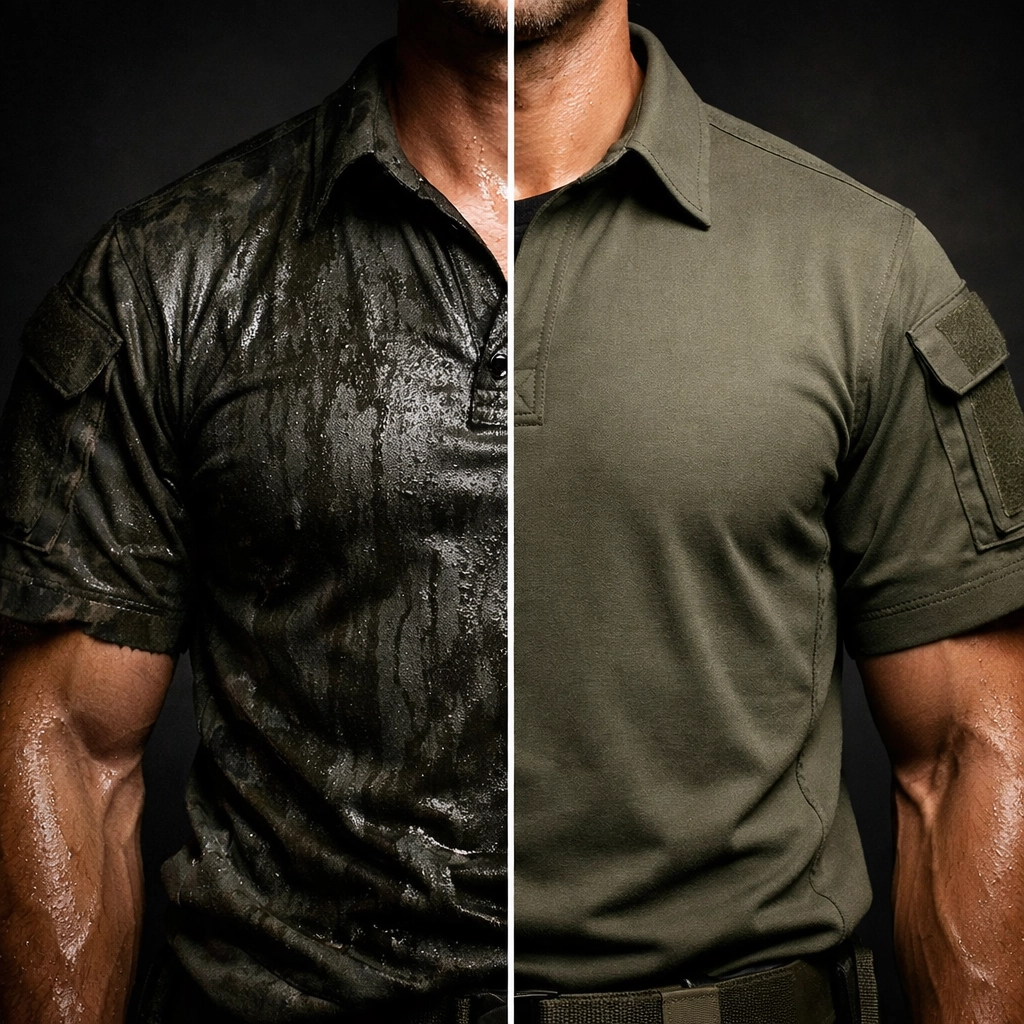
We also carry some 100% cotton options for people who prioritize comfort over performance: because sometimes you just want to throw on a comfortable shirt with a solid graphic and not think about it. That's fine. Know what you're buying and why.
The key is understanding the trade-offs. Poly-cotton dries faster, lasts longer, and performs better under stress. Cotton feels better, breathes naturally, and works great for low-intensity situations. Neither is wrong. But one might be wrong for you.
The Real-World Test
Here's how I test fabric: wear it hard for a day.
Put on the shirt. Go train. Go ruck. Go work outside in the heat. Push until you're drenched. Then ask yourself:
- Is this shirt still comfortable or is it clinging to me?
- Did it dry out during breaks or is it still wet?
- Are there chafe points developing?
- Does it still look decent or does it look thrashed?
That test will tell you everything you need to know about fabric quality. Marketing copy won't. Reviews from people who wore it once won't. Your own experience will.
If you're sweating through a 100% cotton tactical shirt and it's still soaked two hours later, that's not a mystery: that's physics. Cotton absorbs. Polyester wicks. Blends do both.
The Bottom Line
Fabric choice isn't sexy. It's not the part of tactical shirts that gets attention. But it's the part that determines whether your gear actually works or just looks like it should.
Poly-cotton blends are the standard for a reason: they perform. They handle moisture better, last longer, and maintain their shape through repeated use and washing. They're the tactical choice.
100% cotton has its place for casual wear and low-intensity situations where comfort matters more than performance. It's not wrong: it's just different.
At Thirty Seconds Out, we build tactical shirts for people who expect their gear to work. We use proven fabric blends, form-fitting cuts, and designs that mean something. Because when you're committed to the Expect to Self Rescue mindset, you don't have room for gear that fails.
Choose your fabric based on how you'll actually use it. Know the trade-offs. And don't settle for shirts that look tactical but perform like trash.
Your gear should work as hard as you do.

